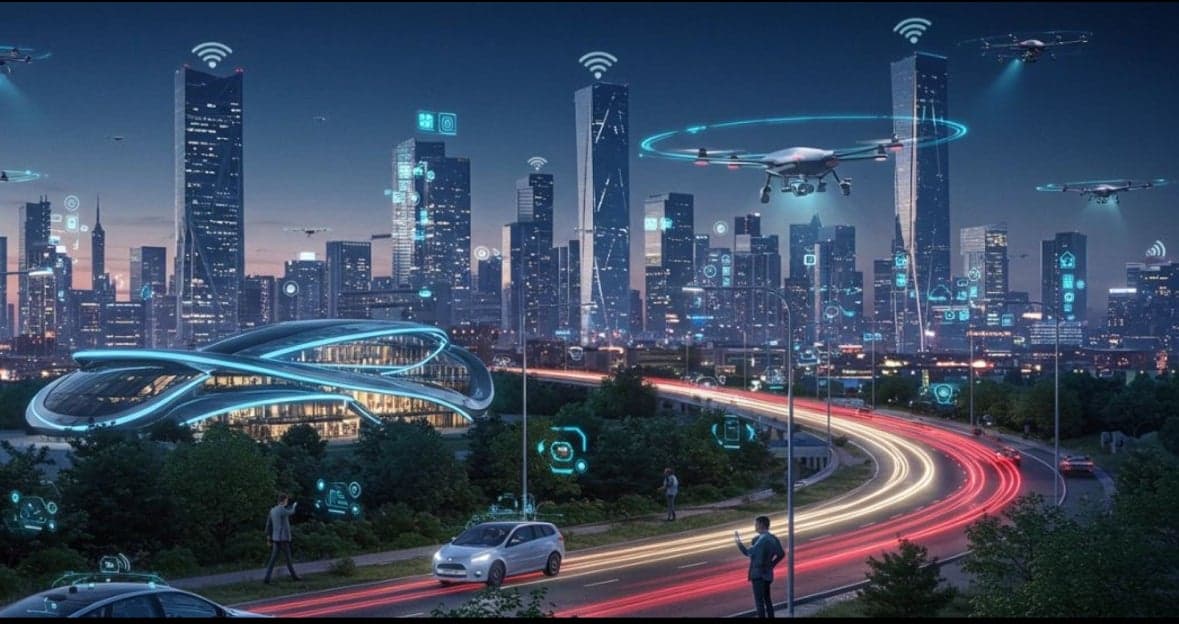
The cities shaping the future of global trade are not just expanding, they are becoming intelligent, connected, and strategically optimized ecosystems.
As economies evolve, the real competitive advantage is no longer just access to markets, but access to smart, integrated logistics ecosystems that enable real time decision making, and scalable global operations. At the core of this transformation lies a powerful intersection of smart cities and advanced logistics systems, a convergence that is reshaping how supply chains operate, and industries connect worldwide.
This is not just an infrastructure shift; It is a fundamental reengineering of global trade.
From Logistics to Intelligent Trade Ecosystems
Logistics has long been the backbone of commerce. Today, it’s becoming one of its most strategic layers.
Driven by advancements in:• Artificial intelligence and predictive analytics
• Smart warehousing and automated distribution
• Real time tracking and data visibility
• Integrated multimodal transport systems
At the same time, smart cities are embedding these capabilities into their urban frameworks, creating environments where infrastructure, mobility, and technology operate as one system. In this new model cities are not endpoints in supply chains, they are intelligent hubs within global trade networks.
Jebel Ali Free Zone: A Model of Integrated Trade
One of the clearest examples of this evolution is the Jebel Ali Free Zone (JAFZA) in the UAE widely recognized as a global benchmark for logistics-driven economic ecosystems.
JAFZA currently hosts over 450 Chinese companies, including 11 Fortune 500 firms, highlighting its role as a key gateway for China led trade expansion.
The scale of operations is equally significant:• Jebel Ali Port handled over 960,000 vehicles in 2024, with China as its largest automotive trade partner
• The port connects to more than 400 global destinations, enabling seamless international distribution
• Over 60% of Chinese exports entering the UAE are reexported globally, positioning JAFZA as a critical redistribution hub
This integration transforms trade into a unified ecosystem where infrastructure supports efficiency, scalability, and sustained growth.
The Greater Bay Area: Scaling the Model Globally
A similar transformation is underway in China’s Greater Bay Area (GBA) one of the most influential economic regions in the world.
Guangzhou is emerging as key node within this ecosystem, combining advanced industrial production, digital commerce and logistics platforms, strategic geographic positioning and high speed connectivity across regional and global markets
The GBA is evolving into a continuously integrated trade system where cities function as interconnected engines of growth. The alignment between these two regions UAE and China creates a powerful bi directional trade corridor, linking together Asianmanufacturing capability with Middle Eastern logistics infrastructure.
The Impact: Redefining Trade, Investment, and Cities
The integration of smart cities and logistics is reshaping the global economy in three key ways:
1. Trade Becomes Faster and Smarter
Supply chains are no longer fragmented, they are integrated, data led systems capable of real time adaptation.
2. Cities Become Economic Platforms
Urban centers evolve into hubs of trade, technology, and production not just consumption.
3. Investment Moves Toward Infrastructure Ecosystems
Capital is increasingly directed toward environments where logistics, innovation, and market access are interconnected.
AIM Talks China: Where Infrastructure Meets Opportunity
Recognizing this shift, AIM Talks China 2026 a focused initiative designed to engage with the infrastructure shaping global trade. Taking place on 17–18 June 2026 in Guangzhou, AIM Talks positions itself at the intersection of: smart cities, logistics transformation and cross border trade ecosystems.
It is designed as a strategic access platform, connecting global investors and decision makers with the real systems driving economic activity. Participants gain direct, practical insight into how smart cities and advanced logistics systems are integrated to drive efficiency and scalability.
This combination of high level dialogue and targeted connections is further strengthened by on ground exposure to the Greater Bay Area’s operational ecosystems, providing a comprehensive understanding of how strategy, infrastructure, and execution come together in real world environments.
Positioning at the Center of Global Trade Evolution
As global trade continues to evolve, the ability to operate within intelligent logistics ecosystems will define competitive advantage.
AIM Talks China places international leaders at the center of this transformation bridging:• China’s industrial and digital scale
• The UAE’s logistics and trade connectivity
• Global capital and investment flows
Access the environments where trade, technology, and capital converge
Join AIM Talks China 2026 and engage with the infrastructure, networks, and opportunities redefining the future of trade.